M6: Dataset, evaluation and fabrication output
Status: done · Commit: see the milestone log
Goal
Test the method on a real, diverse image set without per-image tuning. Measure every design choice against the prior-art baseline, with a protocol that compares like with like. Produce a buildable output.
Dataset (data/dataset.json, experiments/fetch_dataset.py)
30 images: 27 from Wikimedia Commons (public domain, CC0, CC BY, CC BY-SA) plus 3 synthetic
variants. Attribution for every image is in Credits.
The images themselves are downloaded into the gitignored data/raw/.
| category | n | content |
|---|---|---|
| face | 17 | Men, women, children, older people; several skin tones; glasses and beards; studio and busy backgrounds; three-quarter and tilted poses; 3 black-and-white; low-key; small faces in full-body shots |
| hard | 4 | Face mostly covered by a veil (h01), plus synthetic underexposed / low-contrast / washed-out variants of f07 (h02–h04), which have a known clean original |
| animal | 7 | 3 dogs, 4 cats (fur texture, low-key, high contrast) |
| object | 2 | Lighthouses: one busy scene, one white-on-white low contrast |
Curation. Candidates came from Commons "Quality images" categories (men, women, children, dogs, cats, lighthouses) and "Featured pictures of people". Portraits were pre-filtered automatically: exactly one YuNet face, score > 0.85, face height ≥ 15 % of the image. The final set was then picked by hand for diversity. YuNet finds a face in all 21 face and hard images, and also, as a false positive, on the fluffy dog (a01). That one is harmless, since it lands on the dog's face.
Protocol (experiments/evaluate_dataset.py)
| id | method |
|---|---|
| A | Baseline as published (Vrellis / LessWrong greedy, M1 filters), fixed 3,000 lines, line_strength 0.1 |
| B | Same baseline at the line count C chose (controls for line count) |
| C | M2 greedy solver with M1 filters (solver improvement only) |
| D | Full method: M3 filters (auto level stretch, bilateral, CLAHE) + auto importance + M2 solver |
- Same framing for all four methods. The face-centred crop is applied to every method, so each is scored against the same picture. The first attempt framed D differently from A–C, which compared different pictures, and was discarded. The framing effect is reported separately.
- Metrics: SSIM / PSNR after Gaussian blur σ = 2 and 4 px (viewing distance), measured against the plain grayscale photo inside the frame. Face SSIM uses the landmark face oval.
- Synthetic faults (h02–h04) are scored against the clean original. Scoring against the degraded input would count fixing the exposure as an error; the first run did exactly that.
- Fixed settings: 600 px canvas, 256 pins, opacity 0.2, min gap 10. No per-image tuning.
Results
Main comparison (mean over images)
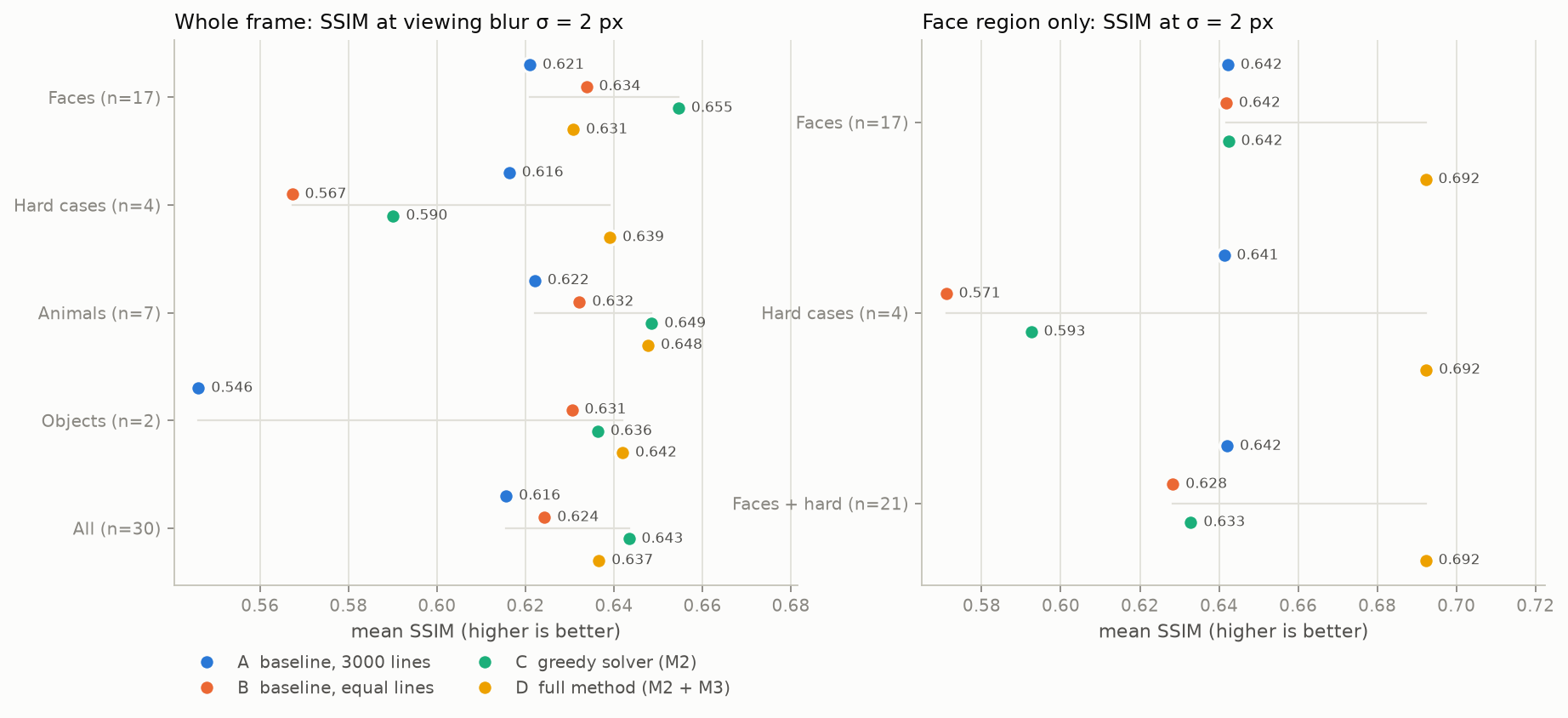
| method | SSIM σ2, all 30 | SSIM σ4, all 30 | PSNR σ2, all 30 | face SSIM σ2, 21 face+hard | lines | time s |
|---|---|---|---|---|---|---|
| A baseline, 3000 lines | 0.616 | 0.800 | 17.29 | 0.642 | 3000 | 8.9 |
| B baseline, equal lines | 0.624 | 0.806 | 18.14 | 0.628 | 2793 | 8.5 |
| C greedy solver | 0.643 | 0.822 | 18.66 | 0.633 | 2793 | 4.7 |
| D full method | 0.634 | 0.818 | 18.83 | 0.690 | 2778 | 4.6 |
Paired, per image:
| comparison | Δ SSIM σ2 (whole frame) | wins | Δ face SSIM σ2 | wins |
|---|---|---|---|---|
| C − B (solver, equal lines) | +0.019 | 29 / 30 | +0.005 | 15 / 22 |
| C − A (solver vs published baseline) | +0.028 | 21 / 30 | −0.009 | 8 / 22 |
| D − C (preprocessing + importance) | −0.010 | 9 / 30 | +0.057 | 22 / 22 |
| D − A (whole method vs published baseline) | +0.018 | 14 / 30 | +0.048 | 20 / 22 |
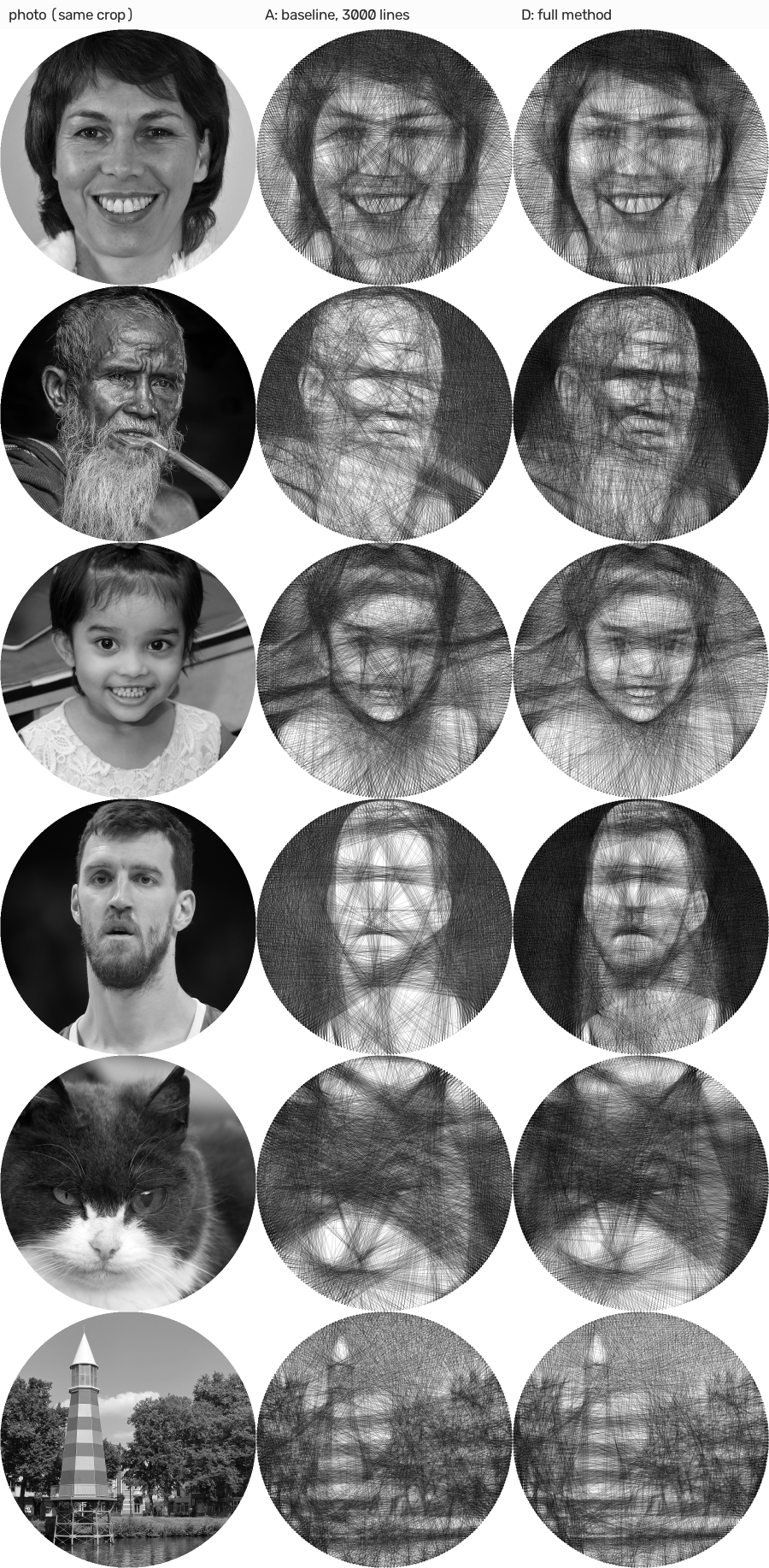
Gallery rows: f07, f16, f13, f05, a04, o01. Photos by the authors listed in Credits (CC BY-SA 3.0 de / 4.0, CC0, CC BY 4.0); the figure is a derivative work shared under the same licences.
Robustness to exposure faults (vs. the clean photo)
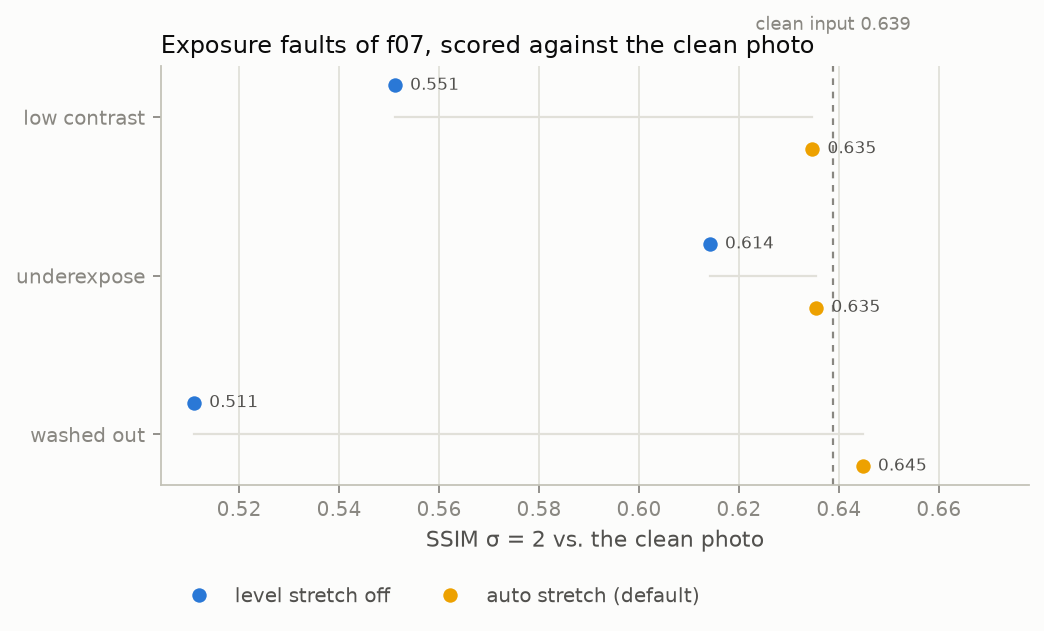
| input | auto stretch | stretch off |
|---|---|---|
| clean f07 (reference) | 0.639 | |
| underexposed (h02) | 0.661 | 0.614 |
| low contrast (h03) | 0.623 | 0.551 |
| washed out (h04) | 0.548 | 0.511 |
SSIM vs. number of lines
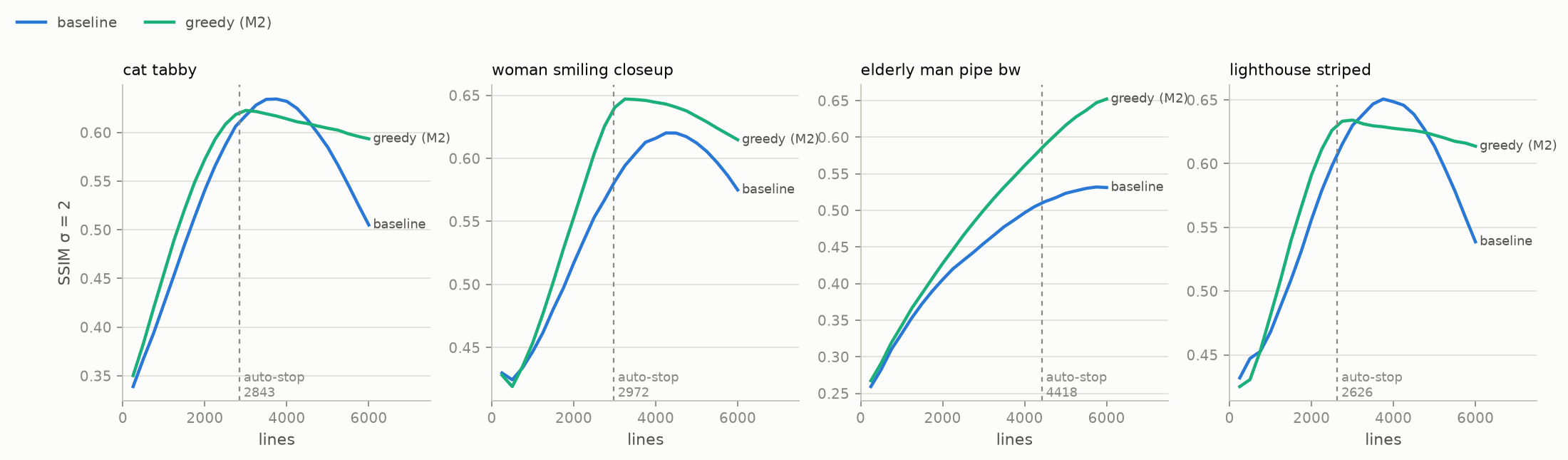
| image | greedy peak (lines) | baseline peak (lines) | greedy auto-stop |
|---|---|---|---|
| f07 woman | 0.647 (3250) | 0.620 (4250) | 2972 |
| f16 elderly man | 0.652 (6000, still rising) | 0.532 (5750) | 4418 |
| a06 tabby cat | 0.623 (3000) | 0.634 (3750) | 2843 |
| o01 lighthouse | 0.634 (3000) | 0.651 (3750) | 2626 |
Pins and thread opacity (full method, 5-face subset)
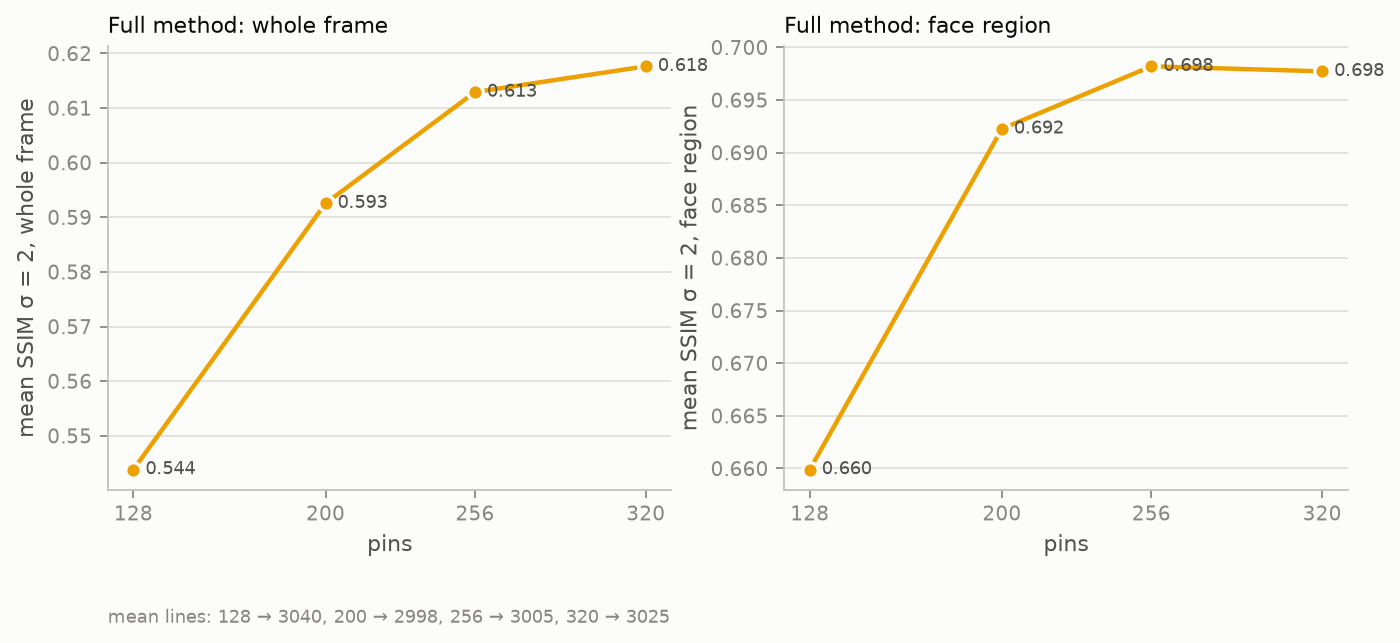
| pins | 128 | 200 | 256 | 320 |
|---|---|---|---|---|
| SSIM σ2 | 0.544 | 0.593 | 0.613 | 0.618 |
| face SSIM σ2 | 0.660 | 0.692 | 0.698 | 0.698 |
| time s | 2.6 | 4.1 | 5.0 | 7.0 |
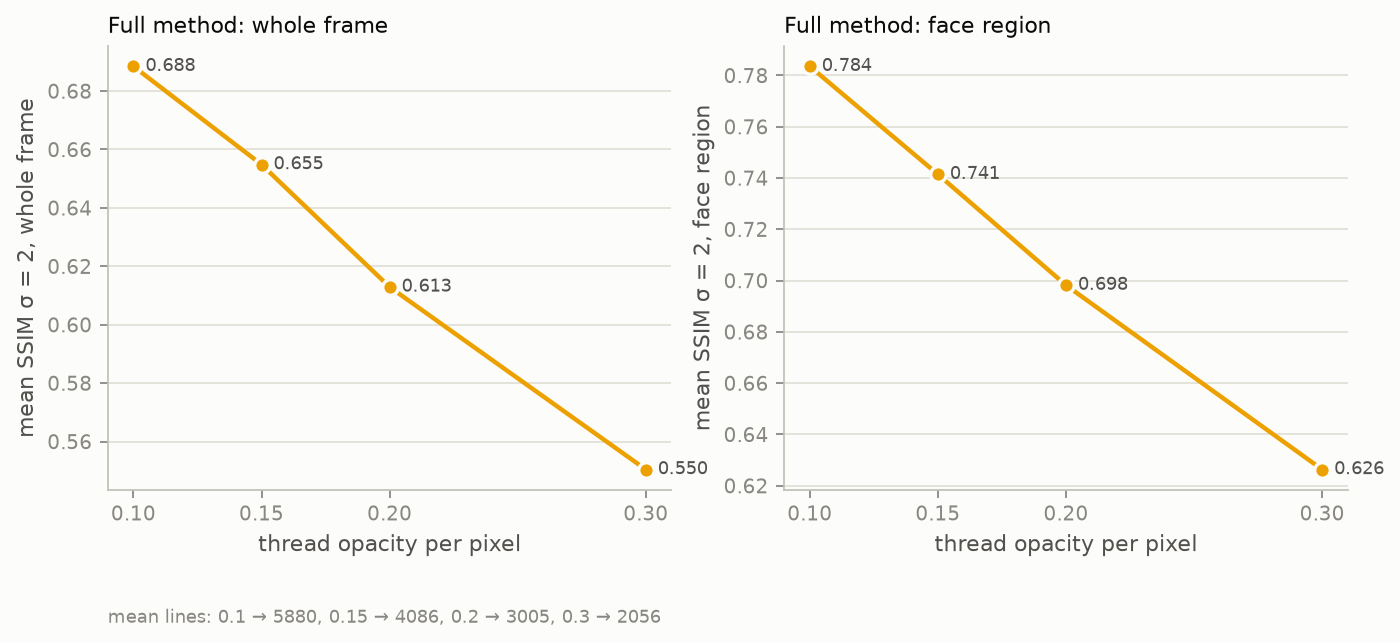
| opacity | 0.1 | 0.15 | 0.2 | 0.3 |
|---|---|---|---|---|
| SSIM σ2 | 0.688 | 0.655 | 0.613 | 0.550 |
| face SSIM σ2 | 0.784 | 0.741 | 0.698 | 0.626 |
| lines | 5880 | 4086 | 3005 | 2056 |
Findings
- The solver is a consistent win. At an equal line count it beats the baseline on 29/30 images (+0.019 SSIM σ2) at about half the run time (4.7 s vs 8.5–8.9 s). It needs no line count or line-strength tuning.
- Preprocessing and importance do what they were designed to do. Face SSIM goes up on 22/22 face and hard images (+0.057 over the solver alone, +0.048 over the published baseline). Whole-frame SSIM drops slightly (−0.010), because importance pulls threads from the background into the face. That trade is intended for portraits. On animals and objects (no face, so uniform weights) D ≈ C.
- Exposure robustness. The auto level stretch recovers all three synthetic faults (+0.037 to +0.072 SSIM). On the underexposed input it even slightly exceeds the clean result. The washed-out case recovers only partially (0.548 vs 0.639), because a gamma shift needs a gamma correction, not a level stretch. An earlier, range-only trigger missed two of the three faults. The final rule (narrow range, or no black point, or no white point) fires on all 3 faults and on none of the 27 natural photos. Caveat: those thresholds were chosen by looking at this set.
- The automatic stop is MSE-optimal, not SSIM-optimal. In 3/4 curves the auto-stop lands within about 250–400 lines of greedy's SSIM peak. On the high-detail f16, SSIM is still rising at 6000 lines while the stop is at 4418. The greedy degrades gracefully past its stop, whereas the baseline collapses (lighthouse: 0.651 → 0.54 by 6000 lines).
- With the line count picked by hand per image, the baseline can win on textured, face-less images under SSIM (cat +0.011, lighthouse +0.017). That choice requires seeing the result, which a user can't do in advance, and on faces the greedy wins by a wide margin (+0.027, +0.120).
- Thread is the biggest physical lever. Halving the opacity (thinner thread relative to the frame) gives +0.075 SSIM and +0.086 face SSIM, at about 2× the lines. More pins saturate after about 256 (+0.005 for 320 pins, at 1.4× the time).
- Framing: the face-centred crop raises the face's share of the canvas from 25.9 % to 31.0 % on this set. The gain is smaller than on the sample images, because these photos are mostly portraits already.
- Known outlier: baseline A on the washed-out h04 scores well (0.614) by accident. Its fixed 3,000 lines over-darken, which happens to offset the washed-out exposure.
Re-run in M8 (Docker, with gamma-aware exposure): only the three synthetic faults change. Full method on hard cases: SSIM σ2 0.618 → 0.639, face SSIM 0.678 → 0.692. Paired: D − A +0.021 (15/30), face +0.051 (21/22); D − C −0.007 (9/30), face +0.060 (22/22). Robustness with stretch + gamma, vs the clean photo (0.639): underexposed 0.636, low contrast 0.635, washed out 0.645 (was 0.548). The thresholds were then checked on a rule-chosen held-out set (M8).
Fabrication output
stringart run … --frame-mm 500 now also writes instructions.txt, a numbered winding list
in 100-line blocks with running thread length, and records thread_length_m in
metrics.json. Pins are numbered clockwise from the top. Thread length is reported in metres
when the frame size is given, else in frame widths.
Limitations and next steps
- Only one physical opacity calibration is assumed. A small test build is needed to fit
opacity(thread width / pixel) to real thread. - No gamma correction for washed-out inputs (finding 3).
- The stop rule could target perceptual error (the blur objective from M2, or an SSIM-aware stop) instead of MSE.
- 30 images, 2 objects: the object category is too small for conclusions.
- M4 (remove/swap refinement) and M5 (colour) are not started.
Reproduce
uv run stringart fetch-models
uv run python experiments/fetch_dataset.py
uv run python experiments/evaluate_dataset.py         # ~25 min; writes outputs/experiments/m6/
uv run python experiments/figures_m6.py --docs